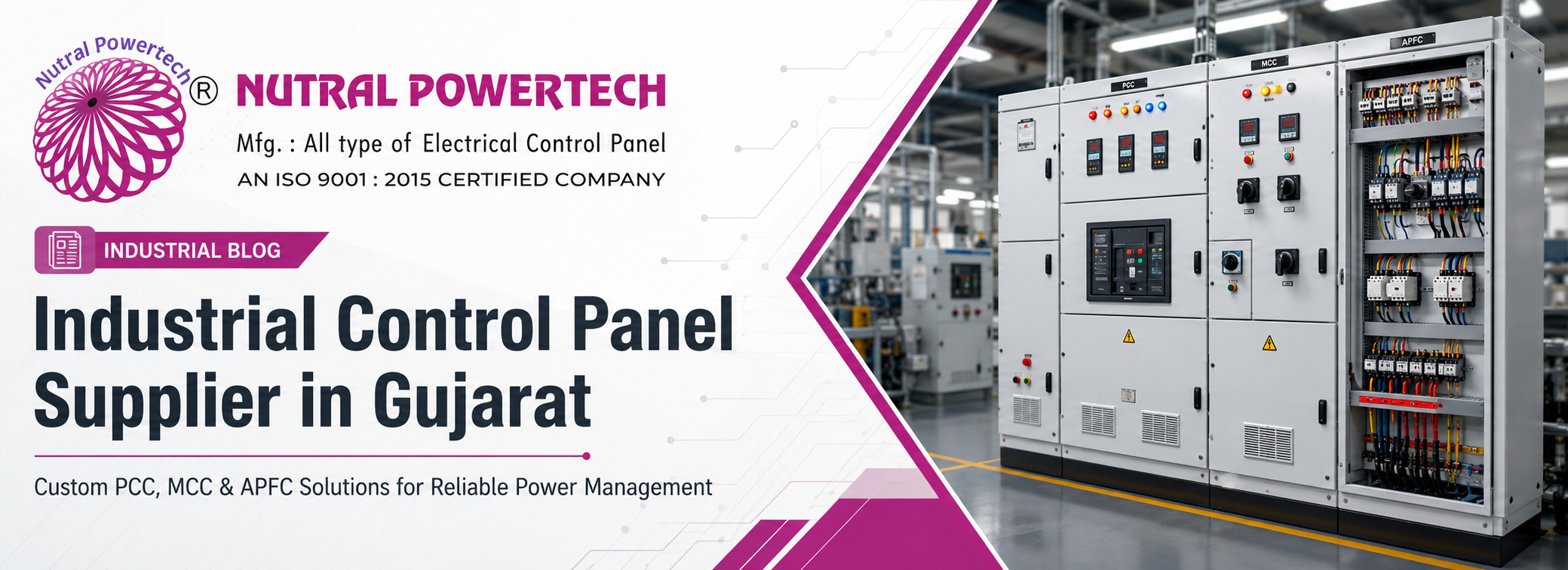
Nutral Powertech · Industrial Blog
Industrial Control Panel Supplier in Gujarat
Nutral Powertech, a trusted industrial control panel supplier in Gujarat, provides custom PCC, MCC, and APFC solutions for reliable power management in Ahmedaba
Why This Matters in Gujarat
Gujarat stands as a significant industrial hub in India, with diverse sectors ranging from chemicals and petrochemicals to textiles, pharmaceuticals, automotive, and heavy engineering. This robust industrial landscape demands sophisticated and dependable electrical infrastructure. As industries expand and adopt more automation, the need for custom-designed, high-quality industrial control panels that can withstand demanding operational environments becomes paramount. Local suppliers who understand the specific regional industrial requirements and can offer timely support are invaluable.
What Is an Industrial Control Panel — Overview
An industrial control panel is an enclosed assembly that contains various electrical components designed to control, monitor, and protect industrial machinery and processes. These panels house devices such as Programmable Logic Controllers (PLCs), motor starters, Variable Frequency Drives (VFDs), circuit breakers, relays, contactors, and human-machine interfaces (HMIs). Their primary function is to provide a centralized point for managing power distribution, motor control, and automation sequences, ensuring safe and efficient operation of industrial equipment. They are essential for everything from simple pump control to complex factory automation systems.
Key Features and Technical Specifications
Industrial control panels are engineered with specific features to meet rigorous operational demands. These attributes ensure safety, efficiency, and longevity in diverse industrial settings.
- Robust Enclosure Design: Constructed from materials like mild steel or stainless steel, offering IP (Ingress Protection) ratings suitable for harsh industrial environments, protecting internal components from dust, water, and corrosion.
- Modular Construction: Allows for easy expansion, modification, and maintenance, adapting to evolving operational requirements without extensive overhauls.
- Integrated Protection Devices: Includes circuit breakers, fuses, and overload relays to safeguard equipment from electrical faults, short circuits, and overcurrent conditions.
- Advanced Motor Control: Incorporates components like Motor Control Centers (MCCs), Variable Frequency Drives (VFDs), and soft starters for precise motor speed, torque, and acceleration control, optimizing energy use and reducing mechanical stress.
- Power Factor Correction (APFC): Features Automatic Power Factor Correction (APFC) relays and capacitor banks to improve power quality, reduce energy losses, and lower electricity bills.
- Human-Machine Interface (HMI) Compatibility: Designed for seamless integration with HMIs for intuitive monitoring, control, and data visualization of processes.
- Compliance with Standards: Manufactured to adhere to relevant national and international electrical safety and performance standards, ensuring operational integrity.
- Efficient Cable Management: Thoughtful internal layout and wiring ducts facilitate organized cabling, simplifying installation, troubleshooting, and future modifications.
Industrial Applications and Use Cases
Industrial control panels are versatile and find application across a broad spectrum of industries, enabling automation, safety, and efficiency.
- Manufacturing Plants: Controlling assembly lines, robotic systems, conveyor belts, and various production machinery.
- Chemical and Pharmaceutical Industries: Managing precise mixing, heating, cooling, and material transfer processes, often in hazardous environments.
- Water Treatment Facilities: Automating pump stations, filtration systems, and chemical dosing for municipal and industrial water management.
- Textile Mills: Regulating machinery for spinning, weaving, dyeing, and finishing processes, ensuring consistent product quality.
- Food and Beverage Processing: Controlling batching, blending, packaging, and refrigeration systems while maintaining hygiene standards.
- Infrastructure Projects: Powering and controlling systems in commercial buildings, airports, and public utilities, including fire pump control and distribution.
- Oil and Gas Sector: Monitoring and controlling pumping stations, pipeline operations, and refining processes, often requiring explosion-proof designs.
How to Choose the Right Industrial Control Panel
Selecting the appropriate industrial control panel requires careful consideration of several factors to ensure it meets specific operational needs and provides long-term value. A systematic approach helps in making an informed decision.
- Assess Capacity and Load Requirements: Determine the total power consumption, motor sizes, and number of circuits the panel needs to manage. This ensures the panel is adequately sized and prevents overloading.
- Verify Compliance and Certifications: Confirm that the panel adheres to relevant industry standards such as ISI, ISO, and IEC, which are crucial for safety, performance, and regulatory compliance.
- Evaluate Supplier Experience and Track Record: Choose a supplier with a proven history of designing, manufacturing, and installing similar control panels. Their experience indicates a deeper understanding of industrial requirements.
- Consider Customization Capabilities: Assess if the supplier can tailor the panel design to your unique process, space constraints, and specific component preferences, rather than offering only off-the-shelf solutions.
- Inquire About After-Sales Support: Understand the scope of post-installation services, including maintenance, troubleshooting, spare parts availability, and technical assistance, which are vital for operational continuity.
- Examine Component Quality: Ensure that the panel is built with high-quality, reputable electrical components from trusted brands, as this directly impacts the panel's reliability and lifespan.
- Review Safety Features: Look for integrated safety mechanisms such as emergency stop buttons, interlocks, and proper grounding, which are essential for protecting personnel and equipment.
Quality Standards and Compliance
Adherence to stringent quality standards and compliance regulations is non-negotiable for industrial control panels. These standards ensure the safety of personnel, the reliability of operations, and the longevity of the equipment. Buyers should verify that a supplier's panels meet relevant Indian Standards (IS), International Electrotechnical Commission (IEC) standards, and potentially ISO certifications for quality management systems. Certifications like ISI mark for specific components or overall panel assembly indicate that the product has undergone rigorous testing and meets defined safety and performance criteria. Ensuring compliance helps mitigate risks, avoids costly downtime, and ensures smooth integration into existing industrial infrastructure.
Why Company Experience and Capability Matters
The complexity and critical nature of industrial control panels demand a supplier with deep experience and robust technical capability. Nutral Powertech, established in 2015, has focused on understanding the specific needs of industrial clients in Gujarat. Our manufacturing process emphasizes the use of premium components and rigorous quality checks at every stage, from design to final assembly. The technical team possesses the expertise to design and produce a comprehensive range of panels, including PCC, MCC, APFC, LT, Distribution, and Fire Pump Control Panels, tailored to diverse industrial applications. This capability ensures that each panel is not only built to specification but also engineered for reliable performance and durability in demanding operational environments. We prioritize delivering customized electrical solutions and providing responsive after-sales support, which is essential for maintaining operational continuity for our clients.
Installation, Maintenance and Care Tips
Proper installation and regular maintenance are crucial for maximizing the lifespan and ensuring the reliable operation of industrial control panels. Following best practices can prevent unexpected downtime and costly repairs.
- Professional Installation: Always engage qualified electricians or engineers for installation. Ensure the panel is mounted in a suitable environment, away from excessive heat, moisture, and vibrations, with adequate ventilation.
- Regular Visual Inspections: Periodically check for any signs of wear, loose connections, discolored wiring, or dust accumulation. Look for any unusual sounds or smells emanating from the panel.
- Cleaning: De-energize the panel before cleaning. Use dry, non-conductive methods like vacuuming or compressed air to remove dust and debris from inside the enclosure. Avoid using liquids.
- Component Checks: Verify the functionality of circuit breakers, relays, contactors, and other critical components. Test safety devices like emergency stop buttons regularly.
- Thermal Scanning: Conduct infrared thermal scans periodically to identify hot spots within the panel, which can indicate loose connections or overloaded circuits.
- Tighten Connections: Over time, vibrations and thermal cycling can loosen electrical connections. Regularly check and tighten all terminal screws and busbar connections.
- Documentation: Maintain up-to-date wiring diagrams, component lists, and maintenance logs. This documentation is invaluable for troubleshooting and future upgrades.
- Professional Servicing: Schedule periodic professional servicing by experienced technicians. They can perform comprehensive diagnostics, calibration, and preventive maintenance tasks that extend the panel's operational life.
Frequently Asked Questions
The primary function of an industrial control panel is to centralize the control and monitoring of industrial machinery and processes. It houses electrical components that manage power distribution, motor operations, and automation sequences, ensuring equipment operates safely, efficiently, and according to programmed logic. This centralization simplifies operation and troubleshooting for complex systems.
PCC (Power Control Center) panels are designed for the main power distribution in an industrial facility, handling high current loads to various sections. MCC (Motor Control Center) panels, on the other hand, are specifically designed to control and protect multiple electric motors from a central location, integrating motor starters, circuit breakers, and overload relays for each motor.
Power factor correction (PFC) is crucial in industrial settings because a low power factor leads to inefficient energy use, higher electricity bills due to penalties from utility providers, and increased load on electrical infrastructure. APFC panels automatically improve the power factor, reducing reactive power, enhancing system efficiency, and freeing up capacity in the electrical network.
The lifespan of an industrial control panel is influenced by several factors, including the quality of its components, the environmental conditions it operates in (temperature, humidity, dust), the frequency and quality of maintenance, and the consistency of its electrical load. Panels built with robust materials and high-grade components, coupled with regular care, tend to last longer.
Yes, industrial control panels can be extensively customized to meet the unique requirements of specific applications. Customization options include panel dimensions, enclosure materials, specific component brands, integration with existing systems, specialized protection features, and unique control logic. This ensures the panel precisely fits the operational needs and space constraints of a facility.
Key safety features to look for in an industrial control panel include proper grounding, clearly labeled emergency stop buttons, interlocks to prevent unauthorized access or operation, adequate short-circuit and overload protection, and appropriate IP ratings for environmental protection. These features are essential for protecting both personnel and valuable equipment from electrical hazards.
Conclusion
The reliable operation of any industrial facility in Gujarat hinges significantly on the performance of its electrical control panels. These critical components ensure that machinery functions efficiently, safely, and in line with operational demands. Choosing a supplier with a strong foundation in technical expertise, a commitment to quality, and the capability to provide customized solutions is essential. Focusing on factors like compliance with standards, robust construction, and dependable after-sales support will ensure that your industrial control panel investment contributes to sustained productivity and operational excellence.
Get In Touch
Nutral Powertech